
We rebuilt contract review from a single email address.
Here is what changed.

Most of the contract review market still runs on the same playbook it ran on twenty years ago. The GC sends an email. Someone reads it three hours later. A partner forwards it to an associate. The associate gets to it the next day. Four days pass. A redline comes back. Half of it is generic, because the lawyer reviewing it has not seen this company’s last five contracts and does not know what the GC has already pushed back on.
The thing that always made me uncomfortable, as both a lawyer and a builder, is how much of the friction in contract review has nothing to do with the law. It is operational. It is communication. It is memory.
So we rebuilt the whole thing. The entry point is a single dedicated email address for each client. Everything the client sends comes through it. Everything we send goes through it. Behind that email address sits a system I want to walk you through, because I think it changes what a corporate client should expect from their lawyer in 2026.
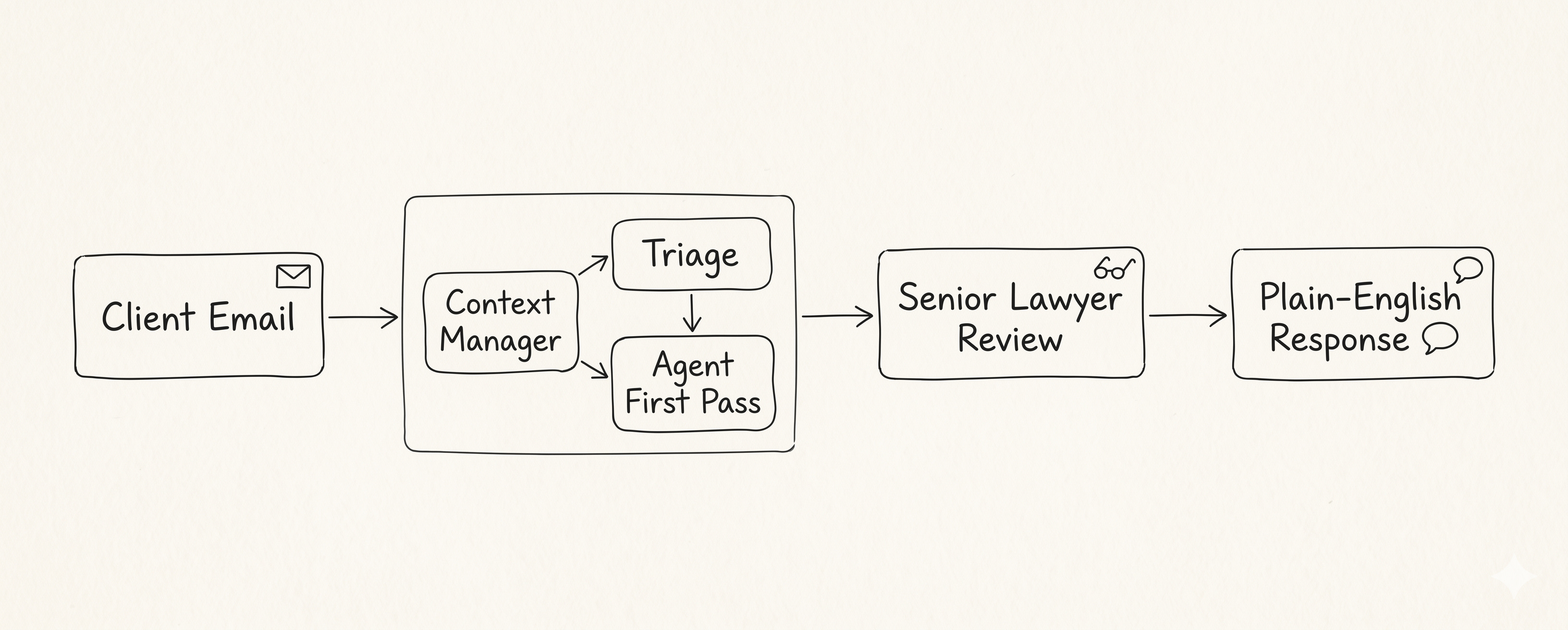
1. The client context manager: institutional memory that does not walk out the door
Every GC I have spoken to has the same story. The senior partner who knew everything about them moved to a different firm. The new team was assigned. There was a knowledge transfer call that lasted thirty minutes. Six months later, the GC is sitting in a meeting explaining, again, that their parent company has an unusual approval matrix, that their MD does not sign anything with uncapped indemnities, that their procurement team has specific positions on data localisatio.
We built this so that this does not happen anymore.
Every email a client sends, every document, every instruction, every redline we send back, all of it feeds a structured client memory layer. The system captures prior negotiating positions, fallback language that worked, counterparty history, the clauses the client has pushed back on before, the risks they care about, the ones they have never cared about, the GC’s preferred tone in cover emails, the commercial priorities that sit underneath the contract terms.
Any lawyer who picks up a matter for this client starts from the full institutional history. The client does not re-explain anything. The context is already loaded. Every new instruction adds to it. The longer a client works with us, the smarter the system gets at serving that specific client.
For an SMB or mid-market corporate that does not have a large in-house team, this changes the relationship completely. They get the equivalent of a senior partner who has worked with them for a decade, available to whoever is staffed on the matter, from day one.
2. Response-time certainty: the silence problem, solved
The worst part of working with outside counsel has always been the silence. You send a document on a Monday. You hear back Thursday. Nobody told you it would be Thursday. You assumed Wednesday. Your closing was Wednesday.
When a document hits the inbox, our system reads it within minutes. It assesses length, clause complexity, the risk profile of the document type, the client’s specific risk thresholds, the deadline if one is stated, and our current bandwidth across the team. Within minutes, the client gets a committed turnaround time. Not a vague estimate. A time.
That commitment becomes the contract between us and the client. They plan around it. Their internal teams plan around it. If the document is a routine NDA and we can return it in four hours, we say four hours. If it is a complex master services agreement with cross-border data flows that needs eight hours of senior review, we say eight hours. If it is an investment agreement that needs a full day, we say a full day.
The relationship runs on predictability. The client never has to chase, never has to wonder, never has to write the polite follow-up email that every in-house lawyer has written a hundred times.
This matters more in our market than people acknowledge. GCs are often running lean teams against international counterparties with full legal departments. The mismatch in response speed is felt every single day. Closing this gap is one of the highest-leverage things you can do for a company doing global business.
3. Senior time on judgment, where it actually matters
The first pass on a contract is the part of legal work that benefits most from AI. Our agents read the document, mark it against the client’s playbook, flag every deviation from agreed positions, score the risks, draft the redlines in the client’s preferred fallback language, and produce a margin-note summary that ranks the issues by severity.
The senior lawyer opens the file and finds the work eighty percent done. Her attention goes to the three or four clauses that genuinely need her judgment. The novel point. The unusual counterparty position. The risk that sits at the intersection of legal and commercial that the agent can identify but cannot resolve.
The deliverable that goes back to the client is not just a marked-up document. It includes a plain-English email that explains what we changed, why we changed it, what we accepted from the counterparty, and what the client should think about before signing. The business team can read it without a translator. The CFO can read it. The founder can read it. Advice stops being a black box that only the legal function can interpret.
This last piece is what most of the legal AI conversation still misses. The senior lawyer’s value is in judgment and in making that judgment legible to the people who have to act on it. Everything else around her work should be designed to free her up for exactly those two things.
What this means for the client
The context manager makes the first pass more accurate, because the agents work from the client’s specific playbook. The triage layer is more accurate, because the system knows what kind of document this client typically sends. The first-pass output is more useful, because it reflects the client’s actual preferences.
The result is something I have wanted to deliver as a corporate lawyer since I started practising. Contract review at speed, with full institutional context, with senior judgment applied where it matters, with advice that the business can actually use.
Contract review stops being a staffing problem. Volume is no longer constrained by how many associates you can hire. It is constrained by how good the system around the senior lawyers is.
That changes the economics. It changes who we can serve. And it changes what the work itself looks like for the people doing it.